Creatine Isn't Just for Lifters: The Cognitive and Longevity Case
Creatine is the most-studied supplement in sports science, and the last decade of research has quietly moved it from 'muscle powder' to 'nootropic and longevity tool.' Here's what the data actually shows for brain, bone, and aging, and how to take it without the myths.
Explore more in Longevity.
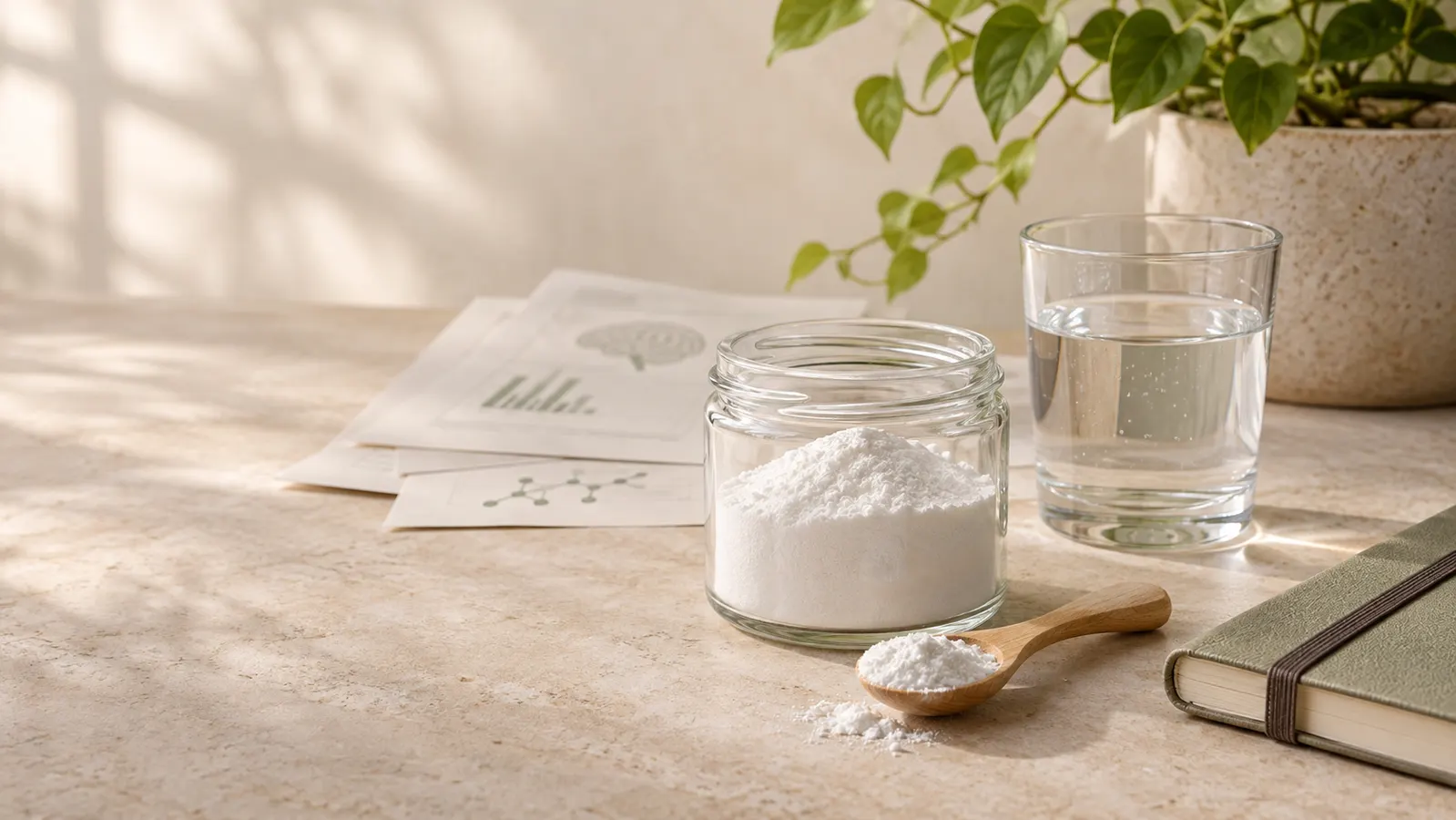
If you polled 100 gym-goers on what creatine does, 95 of them would say 'helps you build muscle,' and they'd be right, but they'd be describing about a third of what it actually does. Creatine is the single most-researched sports supplement in history, with more than 500 peer-reviewed human trials behind it, and the last decade of that research has quietly reframed it as something much broader than a bodybuilding ingredient. It's now understood as one of the most well-established nootropics, one of the more promising interventions for age-related muscle loss, and possibly a useful adjunct for depression. The lifters got there first, but they aren't the whole story anymore.
This is the piece I wish someone had handed me a decade ago, when I was still under the impression creatine was for meatheads and would somehow damage my kidneys. Neither of those things is true, and the cost of skipping it for a decade, for me, for my aging parents, for a lot of women who were told it wasn't for them, is measurable in strength, sleep quality, and cognitive resilience. Let's go through what the evidence actually says.
What creatine actually does in the body
Creatine is a small molecule your body already makes, mostly in the liver, and stores in muscle and brain tissue as phosphocreatine. Phosphocreatine is the fastest energy currency you have, it regenerates ATP in seconds during any short, high-intensity effort (a sprint, a heavy set, a burst of hard thinking) before your slower aerobic systems catch up. The natural stores are enough to keep you alive and functional, but they're not saturated; supplementing with 3–5 grams a day raises muscle stores by roughly 20% and brain stores by 5–10%. That extra buffer is what produces the effects, in muscle and cognition alike.
The mechanism is why creatine's effects show up most clearly in tissues that spike their energy demand fast: skeletal muscle during heavy lifting, but also brain regions during demanding cognitive tasks and under conditions of sleep deprivation or stress. The 'more energy on tap when you need it' framing is oversimplified but not wrong, and it explains why the observed benefits cluster around performance under load rather than baseline function.
"Creatine monohydrate is the most extensively studied dietary supplement and has been shown to enhance performance, recovery, injury prevention, and cognitive function. The evidence base is stronger than for almost any other supplement."
, International Society of Sports Nutrition, 2021 position statement
The muscle and bone case (still real, still underrated)
The most consistent finding across meta-analyses is a 5–15% improvement in strength and power output when creatine is combined with resistance training, along with a 1–2 kg increase in lean body mass over 4–12 weeks. That's not a bodybuilding-specific effect, it's just as important, arguably more important, for the 65-year-old trying to preserve enough muscle to get off the toilet unassisted in their 80s. Sarcopenia (age-related muscle loss) is one of the strongest predictors of losing independence, and creatine plus a modest resistance program is one of the few interventions with robust evidence for slowing it.
The bone data is newer and less encouraging than the muscle data. A two-year randomized trial in postmenopausal women found creatine plus exercise had no effect on bone mineral density at the femoral neck, hip, or spine, though it did improve some measures of bone geometry at the hip. So while creatine plus resistance training is a solid bet for muscle in aging women, the evidence does not show it preserves bone density, and it should not be sold as a bone supplement.
The cognitive case
The brain also runs on ATP and stores phosphocreatine, and it turns out you can measurably increase brain creatine with oral supplementation, MRS scans confirm 5–10% increases over 4–6 weeks. That translates into measurable cognitive benefits, but the pattern is specific: creatine doesn't seem to make well-rested, well-fed people meaningfully smarter at baseline. What it does is protect performance when the brain is under load. Sleep-deprived, calorically restricted, or mentally fatigued populations consistently show improvements in working memory, reaction time, and executive function on creatine versus placebo.
A 2018 review found the cognitive benefits were largest in vegetarians (whose baseline creatine intake from food is lower), older adults, and people in acute sleep debt. For a general adult population getting 7-9 hours of sleep and eating some meat, the honest read is narrower: a 2023 memory meta-analysis first reported a benefit, but after a published letter flagged double-counted data, the authors re-ran the numbers and the overall effect was no longer significant. The signal that survived was in older adults, where the effect was large. For anyone who's a parent of small children, works nights, travels across time zones, or is over 60, the effect is larger and more practically useful. This is the case for why creatine is a good idea even if you never lift a weight.
The depression and mental health data
This is the newest and most interesting frontier. Multiple randomized trials have now shown that creatine (5g/day) added to standard SSRI treatment for major depression accelerates and deepens the antidepressant response, particularly in women. The effect is modest but consistent across trials, and the mechanistic hypothesis, depression involves impaired brain energy metabolism, creatine improves it, has independent supporting evidence from imaging studies. Creatine is not a substitute for depression treatment, but as an adjunct it's cheap, safe, and shows up repeatedly in the literature.
The takeaway isn't 'take creatine instead of talking to your doctor.' It's 'if you're already dealing with mood issues and looking at cheap, low-risk adjuncts, creatine has better evidence than most of the things people try.' Combined with the fact that it's helping muscle and cognition at the same dose, the risk-reward is unusually good.
How to actually take it
The protocol is boring, which is part of why it works. 3–5 grams a day, taken at any time (timing doesn't matter for the long-term effect), with any beverage. Skip the 'loading phase', it just saturates your stores in a week instead of a month, and the endpoint is identical. Take it every day, including rest days. Expect 1–2 kg of water weight in the first month as your muscles hold slightly more water; this is a feature, not a side effect, and it plateaus.
- 3–5g creatine monohydrate daily, any time of day
- Any beverage works, water, coffee, protein shake, juice
- Take on rest days too, you're building stores, not fueling a workout
- Skip the loading phase unless you want the effect in 7 days instead of 28
- Expect 1–2 kg of water weight in the first month; it plateaus
- Drink normal water, creatine doesn't cause dehydration
The myths worth killing
Creatine does not damage kidneys in people with healthy kidneys, this myth traces back to a single 1998 case report that has been contradicted by every subsequent controlled trial. It does not cause hair loss (one small study found a DHT increase; no study has ever shown creatine causing hair loss). It does not cause bloating in the classic sense, the water it retains is intracellular, in the muscle, not subcutaneous, so it doesn't make you look puffy. And it is not a steroid, an androgen, or anything that requires cycling off. You can take it for decades.
The one real caveat: about 20% of people are 'non-responders' whose baseline creatine stores are already high (usually heavy meat eaters) and who see smaller effects. If you eat 4+ servings of red meat a week, your bump will be smaller. If you're a vegetarian or vegan, your bump will be dramatic, and creatine is arguably the single most impactful supplement you can add.
The one-line version
Creatine is 3-5g of monohydrate powder a day, taken forever, with better evidence behind it than 95% of the supplement aisle. It helps muscle and strength (well-known), but also cognition under load and depression as an adjunct to treatment (less well-known and more interesting). Bone density is not one of the proven benefits: a two-year trial in postmenopausal women found no effect on bone mineral density. It's cheap, safe, and one of the few supplements where the risk-reward is genuinely lopsided in favor of just taking it.
Continue with The 10-Minute Walk After Meals: A Small Habit With a Useful Payoff, Grip Strength: The Overlooked Longevity Marker Nobody Trains and Zone 2 Cardio: The Longevity Workout You're Skipping.
Questions readers ask about creatine isn't just for lifters: the cognitive and longevity case
Creatine is the most-studied supplement in sports science, and the last decade of research has quietly moved it from 'muscle powder' to 'nootropic and longevity tool.' Here's what the data actually shows for brain, bone, and aging, and how to take it without the myths.
Anyone with a diagnosed condition, concerning symptoms, pregnancy, or medication questions should check with a qualified clinician before changing their routine.
Start with the smallest practical change, track how you respond, and stop or seek professional guidance if it causes pain, distress, or unexpected symptoms.
Sources & Peer-Reviewed References
- Effects of creatine supplementation on memory in healthy individuals: a systematic review and meta-analysis of randomized controlled trials· Nutrition Reviews / PubMed
- Effects of creatine supplementation on cognitive function of healthy individuals: A systematic review of randomized controlled trials· Experimental Gerontology / PubMed
- A randomized, double-blind placebo-controlled trial of oral creatine monohydrate augmentation for enhanced response to a selective serotonin reuptake inhibitor in women with major depressive disorder· American Journal of Psychiatry / PubMed
- Effects of Creatine Supplementation on Renal Function: A Systematic Review and Meta-Analysis· Journal of Renal Nutrition / PubMed
Tools referenced in this piece
Thorne Creatine Monohydrate
BowFlex SelectTech 552 Adjustable Dumbbells
WHOOP 5.0 Activity Tracker
beingvela is reader-supported. Some links are affiliate links, we may earn a small commission at no extra cost to you.
Prices are snapshots and change over time.
Shop the Everyday Essentials
The tools and gear we actually use, curated and tested by our editors.
Browse essentialsGo deeper with a guide
Foundations of Strength
The beginner-friendly framework to build lifelong strength with just three movements, twice a week.
Read the guide GuideThe Sleep Reset
A 14-day protocol to fix your circadian rhythm, deepen your sleep, and help you wake up rested without relying on supplements.
Read the guide GuideEat for Energy
A practical nutrition guide to stabilise blood sugar, sharpen focus, and eat well without counting anything.
Read the guideMore in Longevity
Continue with more practical reading from this category.
 Fitness
Two Days of Strength Training Is Enough to Start
A simple full-body strength plan for adults who want to start with two sessions a week, using manageable volume and room to progress.
 Physical Health
The 10-Minute Walk After Meals: A Small Habit With a Useful Payoff
A short, easy walk soon after eating can reduce the size of the post-meal glucose rise. Here is a practical version that does not turn every meal into a workout.
 Longevity
Grip Strength: The Overlooked Longevity Marker Nobody Trains
Grip strength predicts all-cause mortality better than blood pressure, and most people are quietly losing it every year without noticing. Here's why it matters and how to train it in 10 minutes a week.
 Longevity
Zone 2 Cardio: The Longevity Workout You're Skipping
The unsexy, low-intensity cardio that reshapes your mitochondria, drops resting heart rate, and adds years to your healthspan, done right, and done often.